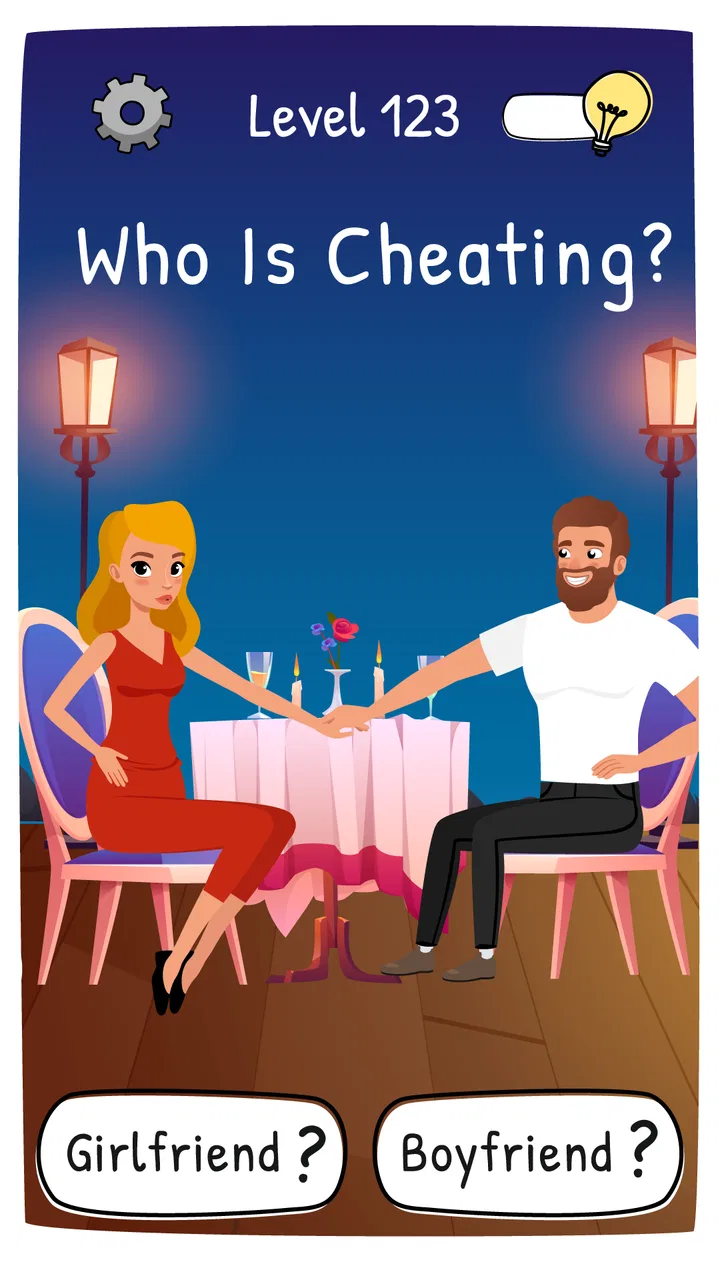
Who is? Brain Teaser & Riddles
- 4.7
- Rating
- 50.00M
- Installs
- Free
- Price

 Analysis by App-foxy
I enjoy trivia games most when they make me stop, look again, and question my first answer. Who is? Brain Teaser & Riddles is built around that kind of small mental trap: each puzzle asks me to identify clues, interpret a situation, or work out which person is lying. It feels closer to a collection of visual mysteries than to a traditional quiz with a fixed subject such as history or science.
That distinction matters. I would not open this game expecting a serious knowledge test or a long story campaign. I play it when I want short bursts of problem-solving, especially when I have a few spare minutes and would rather use my attention than scroll. The puzzles are designed to make me inspect details and challenge assumptions, so the satisfaction comes from noticing the intended clue rather than remembering obscure facts.
How the puzzle loop creates an early goal
The first useful goal is simple: solve the current brain teaser without immediately relying on a hint. That gives each scene a clear purpose from the moment it appears. I look for something that does not fit, consider what the question is really asking, and then choose the answer that best explains the evidence. The wording can encourage a quick reaction, but the better habit is to slow down and examine the whole situation.
You May Also Like

 AccuWeather: Weather Radar
AccuWeather Review: A Quick, Clear Forecast for Everyday Decisions
For everyday plans, the best forecast is the one you can understand quickly. AccuWeather makes rain timing, radar, and local conditions easy to act on, with a few trade-offs.

 Hill Climb Racing
Why Hill Climb Racing Still Turns Crashes Into One More Run
A tiny car, a bumpy hill and one more upgrade: Hill Climb Racing keeps resurfacing because its simple chaos makes every near-miss feel personal.

 AliExpress - Shopping App
AliExpress Makes Global Shopping Feel Personal, but Shoppers Bear the Risk
AliExpress turns a global marketplace into a pocket-sized discovery engine. Its reach is useful, its shopping loop compelling, and its trade-offs easy to miss.

 Lords Mobile: Kingdom Wars
Lords Mobile Is a Kingdom-Building Routine, Not a Quick Match
A case-by-case verdict on the building, battles, device demands, and social commitments that make Lords Mobile rewarding for some players and exhausting for others.

 PDF Scanner app - TapScanner
TapScanner Makes Paperwork Easier to Capture, Check, and Share
TapScanner makes scanning with a phone feel less like a rescue operation and more like a dependable step in getting work done. Its capture tools are useful, though not flawless.

 Block Blast!
 Shows How Much a Puzzle Game Can Leave Out
A quiet grid game shows why puzzle players increasingly value instant clarity, repeatable skill and low-pressure play—and where the genre still needs to catch up.
More From Our News Desk
View All News


This makes the game approachable for casual players. I do not need to prepare, learn a ruleset, or remember a complicated control scheme. The challenge is concentrated in the puzzle itself. A short session can begin with one riddle and end after several solved scenes, which suits commuting, waiting rooms, or a break between tasks.
The early objective also gives the game a useful rhythm: observe, form a theory, answer, and learn whether the theory holds up. When I get a puzzle wrong, the mistake usually tells me something about my reading style. Perhaps I focused on the obvious character, ignored a background detail, or interpreted the question too literally. That makes failure more informative than simply losing a round in a reflex game.
One practical tip is to read the prompt twice before touching the answer. In this type of trivia game, the question often defines the boundaries of the puzzle more precisely than the illustration does. I also try to inspect every person and object before deciding who is suspicious. That small routine reduces random guessing and makes the eventual solution feel earned.
The game comes from Unico Studio, a developer associated here with a broad, accessible brain-game format rather than a specialist trivia niche. It is free to start, which makes trying the opening puzzles easy. The age guidance is Everyone 10+, a reasonable fit for families and younger players who enjoy light mysteries, although parents may still want to check whether the style of deception and peril suits a particular child.
What progress feels like between puzzles
Progress in a game like this is not only about reaching another puzzle. I notice progress in the way I begin to recognize common traps. At first, I may search for the most dramatic clue. After playing for a while, I become more cautious about suspiciously obvious details and start asking what the scene is trying to make me overlook.
That change in perspective is one of the strongest reasons to keep playing. The app turns observation into a habit. I might not remember every individual riddle later, but I do become better at separating relevant information from decoration. For a player who enjoys lateral thinking, that is more rewarding than a simple score counter.
The game’s store rating is 4.7 from around 1.8 million ratings, and it has passed 50 million installs. Those figures suggest that the short-form mystery approach has found a large audience. They do not guarantee that every puzzle will match my taste, but they do help explain why the format works: the premise is immediately understandable, and a single solved scene provides a quick sense of completion.
I would describe the progress signals as psychological as much as mechanical. Solving a puzzle without help feels like a small personal win. Recognizing an intentional misdirection feels like improvement. On the other hand, players who need a deep character system, equipment, or a large map to show advancement may find this lighter structure less satisfying.
For me, the best way to use it is to treat each puzzle as a focused exercise rather than rushing through a checklist. If I am tired, I sometimes miss clues that would be obvious with a little patience. Putting the game down after a stubborn puzzle is often better than spending repeated attempts making the same assumption. Returning later with a fresh view can be surprisingly effective.
The difficulty curve and the value of a second look
The difficulty is likely to feel uneven in the way many riddle collections do. Some scenes can be solved quickly because the key clue stands out once I know where to look. Others require me to reinterpret the wording or compare several details before the answer becomes clear. That variation keeps the experience from becoming a mechanical tap-through, but it can also make the pacing feel less smooth than a carefully staged campaign.
I appreciate that the challenge is usually based on interpretation rather than speed. There is no reason for me to panic over a timer when the real task is to notice an inconsistency. This makes the game more comfortable for players who enjoy puzzles but dislike fast reactions. It also means that a wrong answer feels less like a failure of coordination and more like a failure to inspect the evidence.
A useful approach is to divide each puzzle into three questions: what is directly visible, what the wording implies, and what detail would be unnecessary if the scene were ordinary. The third question is especially helpful. Illustrations in a brain teaser often contain a deliberate irregularity, so I look for the element that seems oddly placed or too carefully emphasized.
Still, I would not call every challenge perfectly fair from a player’s perspective. A riddle can depend on a particular interpretation, and the intended answer may feel obvious only after I see it. That is a normal weakness of visual trick puzzles: the creator controls the intended logic, while the player may reasonably imagine another explanation. If you prefer puzzles with formal rules and one demonstrable solution, a traditional logic-puzzle app may be a better match.
Hints can be useful when I have genuinely exhausted the scene, but I try not to use them at the first sign of difficulty. The more valuable skill here is learning how to search. I first reread the prompt, then inspect the background, then reconsider the relationships between the people shown. Only after those steps do I look for assistance. That workflow preserves the challenge while preventing one confusing puzzle from stopping a session.
Everyday use: a good fit for short attention windows
A realistic use case is a ten-minute wait before an appointment. I can open the game, solve a few mysteries, and stop without needing to remember a complicated plot or reach a safe point. The compact format also works during a coffee break, although I would avoid playing when I need to concentrate on a conversation because the puzzles are more absorbing than their simple presentation suggests.
It can also work as a shared activity. I have found that visual riddles invite discussion because two people may notice different clues. One person can focus on the wording while another scans the scene, then both compare theories. That makes the game more social than a standard multiple-choice trivia quiz, even though the core interaction remains individual problem-solving.
For families, the puzzles offer a way to encourage careful observation without turning the session into schoolwork. I would still recommend helping younger players understand that a wrong answer is part of the process. The Everyone 10+ guidance gives a useful age boundary, but suitability depends on how comfortable a child is with mystery scenarios and misleading characters.
The game is less suitable for someone looking for a relaxing, predictable pastime. Its whole appeal is that it interrupts automatic thinking. If I want to listen to music and play without reading closely, this is the wrong choice. Likewise, players who want competitive leaderboards, detailed statistics, or a conventional trivia curriculum may prefer another category of quiz game.
Where retention pressure helps and where it can irritate
The main reason I return is the promise of another small mystery rather than a large open-ended objective. Each unsolved puzzle creates a modest pull to continue, and every successful answer gives enough closure to make stopping possible. That balance is important: the game can encourage another round without demanding a long uninterrupted session.
There is also a natural curiosity loop. When a puzzle catches me out, I want to understand the trick. That is stronger than simply wanting to increase a number because the solution explains the mistake. The best scenes leave me thinking, “I should have noticed that,” which is exactly the reaction a good brain teaser aims for.
However, repeated misdirection can become tiring. If too many puzzles rely on the same kind of visual trick, I start solving the designer’s habits instead of examining each scene honestly. The collection format can therefore feel more repetitive over a long sitting than it does in short sessions. My recommendation is to play in small groups of puzzles, especially if the challenge begins to feel predictable.
The free entry point is convenient, but the game includes in-app purchases ranging from $1.99 to $14.99 per item. That is worth considering before treating it as a completely cost-free experience. I would start without buying anything and see whether the basic puzzle flow provides enough enjoyment. Players who dislike optional spending pressure should pay attention to how often they feel tempted to seek help or accelerate progress.
Because the current version is 1.14.5 and the minimum requirement is Android 7.0, it is accessible to many older Android devices. That is useful for people who keep a secondary phone for casual gaming. On iOS or Android, the more important practical question is not raw performance but whether the screen is large enough for comfortably examining small visual clues. A larger display makes the observation element easier and reduces the chance of missing a detail because it is hard to see.
How it compares with ordinary trivia and logic alternatives
Compared with a conventional trivia quiz, this game asks less about stored knowledge and more about perception, wording, and lateral thinking. I do not need to know a capital city, sports record, or historical date to make progress. That makes it friendlier to mixed groups, since players are less likely to be separated by their education or specialist interests.
Compared with a pure logic-puzzle app, it is more theatrical and immediate. The scenes give the questions a human context, often asking me to identify a liar or explain suspicious behavior. The trade-off is precision. Formal logic puzzles usually provide a structured set of rules that can be tested step by step, while a visual riddle may depend on noticing the creator’s intended clue.
Compared with an endless arcade game, the reward is slower and more thoughtful. There is no appeal in playing on autopilot. I would choose it over a reflex title when I want my phone to make me think, but I would choose a word game when I want language practice or a classic quiz when I want factual learning. The right alternative depends on whether I value observation, knowledge, or repetition.
One non-obvious trade-off is that the game’s accessibility can reduce its depth for experienced puzzle fans. Because the premise is easy to understand and the individual scenes are compact, it is excellent for casual play but may not satisfy someone seeking a single elaborate mystery with a complex chain of deductions. I see it as a snack-sized puzzle collection, not a replacement for a full investigation adventure.
My progression verdict after weighing the whole loop
Who is? Brain Teaser & Riddles succeeds when I approach it as a quick observation challenge. Its goals are clear, its puzzles are easy to start, and its strongest moments reward patience rather than memorized knowledge. The progression comes from becoming more alert to wording, background details, and deliberate misdirection. That is a genuine form of improvement, even when the game does not feel like a traditional campaign.
Its weaker side is the potential for uneven difficulty and repeated puzzle patterns. Some answers may feel satisfying only after the intended trick is revealed, and long sessions can make the format seem less fresh. The in-app purchase range also means I would avoid assuming that every useful convenience is included in the free experience. These are not deal-breakers for me, but they affect how I recommend playing.
I would suggest it to casual players, families with suitable older children, and anyone who likes solving “who is lying?” scenarios by inspecting clues. I would skip it if I wanted competitive trivia, rigorous deduction, or a substantial narrative adventure. For everyone else, the best strategy is to play slowly, use hints only after a deliberate search, and stop when the puzzles stop feeling mentally sharp.
Overall, I find the game easy to recommend as a free starting point for short brain teasers and riddle games. It does not need a complicated progression system to create momentum; the next unanswered mystery is usually enough. Its lasting appeal depends on how much I enjoy questioning first impressions, and when that style clicks, even a brief session can leave me more observant than when I began.
FAQs for Who is? Brain Teaser & Riddles
01What is the main objective of 'Who is? Brain Teaser & Riddles'?
The main objective of 'Who is? Brain Teaser & Riddles' is to challenge players with a series of engaging puzzles and riddles that test their logical thinking and problem-solving skills. Each level presents a unique scenario where players need to use clues and lateral thinking to find solutions.
02Is 'Who is? Brain Teaser & Riddles' suitable for all ages?
Yes, 'Who is? Brain Teaser & Riddles' is designed to be suitable for players of all ages. The puzzles vary in difficulty, offering a fun and educational experience for both younger players and adults who enjoy sharpening their mental acuity through brain-teasing challenges.
03Does the game offer in-app purchases?
'Who is? Brain Teaser & Riddles' does include in-app purchases. These purchases generally offer hints or unlock additional levels. While the game can be enjoyed without any purchases, players have the option to enhance their experience by buying extra content if they choose.
04Can I play 'Who is? Brain Teaser & Riddles' offline?
Yes, 'Who is? Brain Teaser & Riddles' can be played offline once downloaded. This makes it a great option for users who want to enjoy a fun and challenging puzzle game without needing an internet connection, perfect for travel or when data access is limited.
05What platforms is 'Who is? Brain Teaser & Riddles' available on?
'Who is? Brain Teaser & Riddles' is available on both Android and iOS platforms. Users can download it from the Google Play Store for Android devices and the Apple App Store for iOS devices, ensuring wide accessibility for smartphone and tablet users.
Pros
- Engaging and challenging puzzles.
- Intuitive and user-friendly interface.
- Regular updates with new riddles.
- Improves critical thinking skills.
- Suitable for all age groups.
Cons
- Ads can be intrusive at times.
- Limited hints without purchase.
- Some puzzles are too abstract.
- Requires internet for some features.
- Occasional bugs in older devices.

Who is? Brain Teaser & Riddles
Gallery